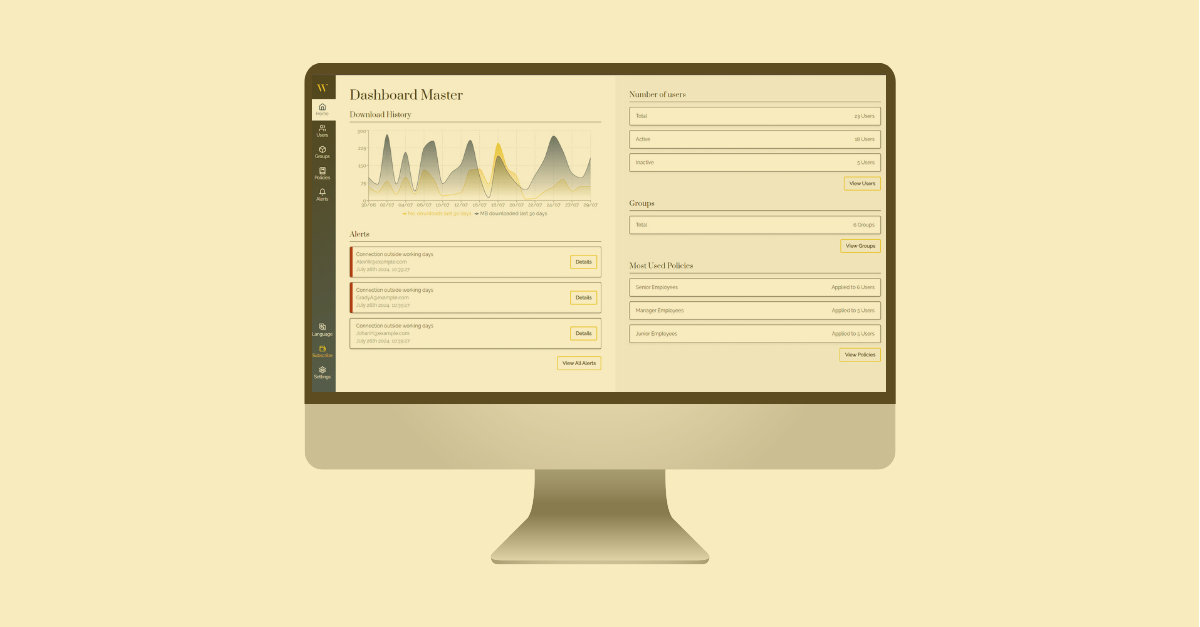
User monitoring has become a necessity for many organizations. Whether to improve productivity, enhance IT security, optimize processes, or ensure regulatory compliance, companies need visibility into how their systems, applications, and digital resources are being used.
However, there is a very fine line between legitimate supervision and excessive surveillance that could violate fundamental privacy rights. In Europe, the General Data Protection Regulation (GDPR) and Spanish data protection regulations data protection establish clear limits on what can be monitored, how it should be done, and what safeguards must be offered to users and employees.
The good news is that it is perfectly possible to monitor user activity legally, ethically, and transparently. In this article, we will analyze the best practices to achieve this without compromising individuals' privacy or risking regulatory penalties.
When we talk about user monitoring, we refer to the collection, analysis, and recording of information related to the use of digital systems.
This may include:
However, monitoring does not mean spying. From a legal standpoint, any processing of personal data must comply with fundamental principles such as lawfulness, transparency, data minimization, and purpose limitation. These principles form the basis of the GDPR and should guide any digital surveillance initiative.
One of the biggest challenges for organizations is finding the right balance between their legitimate interests and users' rights.
Companies have valid reasons to monitor certain activities:
However, employees and users retain their right to privacy even when using corporate devices. Spanish legislation expressly recognizes this right in the workplace, allowing certain monitoring activities provided they are carried out within legal limits and with due safeguards.
The key is to implement proportionate and justified measures, avoiding any form of invasive or indiscriminate surveillance.
Transparency is probably the most important requirement.
Users must know:
The Ley Orgánica 3/2018 requires that employees be clearly informed about the criteria for using digital devices and about the control measures implemented by the company.
Monitoring must be proportionate to the objective pursued.
For example, if a company needs to verify access to sensitive information, it can log access events and security-related activity. However, constantly logging keystrokes, recording conversations, or continuously capturing screens could be considered excessive in many contexts.
The GDPR stipulates that only data strictly necessary to achieve the intended purpose should be collected.
Data collected for a specific purpose should not subsequently be reused for other incompatible purposes.
For example, using access logs collected for security purposes and subsequently employing them to evaluate employee performance might require a new legal assessment and an update to the information provided to users.
Logs are one of the most commonly used tools for monitoring systems in a privacy-compliant manner.
They allow for the recording of:
Their purpose is usually related to security, auditing, and operational traceability.
SIEM, EDR systems, and other cybersecurity platforms collect events that help detect threats, malware, or unauthorized access.
This type of monitoring is often broadly justified for business security reasons, provided it is limited to the necessary data.
Many organizations analyze how certain tools are used to optimize licenses, improve processes, or detect operational issues.
When data is properly aggregated or anonymized, privacy risks decrease significantly.
Geolocation can be used in certain cases, especially when there is a real operational need.
However, Spanish law requires employers to inform workers in advance about the existence of these systems, their characteristics, and the rights associated with data processing.
Some software allows for automatic captures every few minutes.
While technically possible, this practice often poses significant privacy risks because it can record personal information, private conversations, or sensitive data unrelated to work activities.
The keylogging is one of the most intrusive forms of digital monitoring.
Various European data protection authorities have questioned or sanctioned such practices when there is no exceptionally strong justification.
Continuous recording of conversations represents an extremely invasive measure and is rarely justifiable in most work environments.
Monitoring users without prior notification is often incompatible with the principle of transparency and can lead to significant legal liabilities.
Before deploying any tool, the organization must answer a fundamental question:
Why do I need to monitor this activity?
Common objectives include:
The more specific the objective, the easier it will be to justify data collection.
The concept of Privacy by Design promotes incorporating data protection from the initial phase of any technological project.
This involves:
In many cases, it is not necessary to individually identify each user.
Aggregated indicators can provide valuable insights into:
Reducing direct identification significantly lowers legal risks.
When monitoring may involve a high risk to individuals' rights and freedoms, the GDPR requires a Data Protection Impact Assessment (DPIA).
These assessments allow for:
European authorities consider that certain systematic employee monitoring programs may require this type of prior analysis.
It must be explained exactly what information will be collected and how it will be used.
The company must demonstrate that the monitoring addresses a legitimate need.
It is necessary to assess potential impacts on user privacy.
Technical and organizational controls must be defined to minimize these risks.
Organizations implementing monitoring tools should follow a series of practical recommendations.
Overly complex policies generate distrust and may fail to meet transparency requirements.
Information must be clear, accessible, and understandable to all users.
Not all employees need access to the collected information.
Access must be restricted to authorized and properly trained personnel.
Data should not be stored indefinitely.
It is advisable to define retention policies aligned with the objectives and regulatory requirements.
Regular review allows for the detection of:
The most advanced platforms are evolving towards privacy-centric models.
Instead of collecting large amounts of personal information, many solutions prioritize:
This approach provides operational visibility without creating a feeling of constant surveillance or compromising fundamental rights.
Monitoring user activity and respecting privacy are not incompatible goals. In fact, the most mature organizations understand that transparency, proportionality, and data minimization are essential elements for building trust.
The European legal framework allows companies to monitor certain aspects of digital activity when there is a legitimate purpose, provided that users are adequately informed, collected data is limited, and necessary safeguards are implemented.
The difference between legal monitoring and a potentially sanctionable practice is usually not in the technology used, but in how it is designed, communicated, and governed. Therefore, any monitoring strategy should always start from a basic principle: collect only the information necessary to achieve a legitimate objective and do so in the least intrusive way possible. This allows companies to improve security, efficiency, and regulatory compliance without compromising individuals' privacy.